Ancient Lord Vishnu Statue Tragic Destruction in Cambodia: A Wake-Up Call for Global Heritage
A centuries-old statue of Lord Vishnu was deliberately destroyed at the remote Prasat Ta Nei temple in Cambodia’s Siem Reap province, dealing a devastating blow to Southeast Asian cultural heritage. This act of vandalism, which was reported toward the end of December 2025, has sparked outrage across the globe and brought together archaeologists, Hindu devotees, governments, and everyday lovers of heritage in a single cry for retribution and protection.
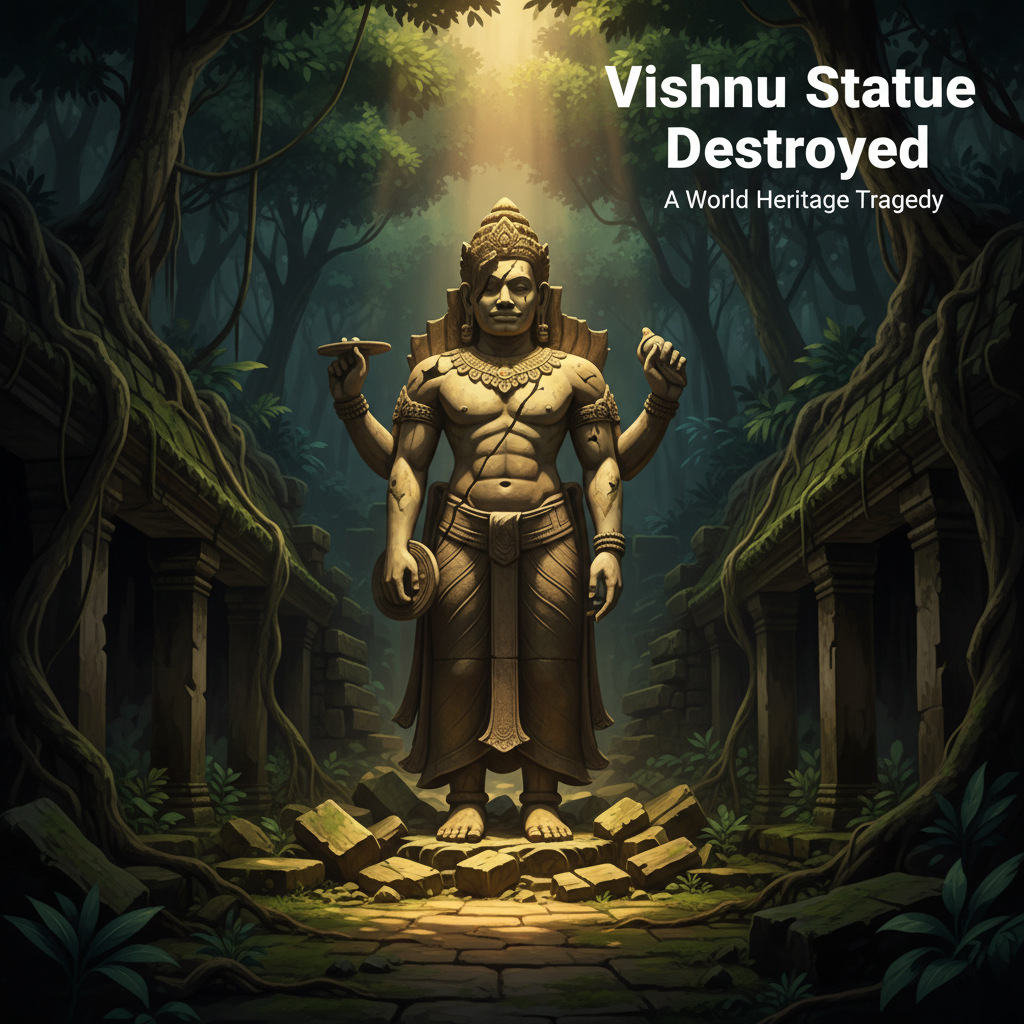
The Statue’s Majesty and Historical Context
This 2-meter-tall sandstone masterpiece depicts Lord Vishnu in his iconic four-armed chaturbhuja form, with a conch (shankha) for the cosmic sound Om, a discus (sudarshana chakra) for destroying evil, a mace (gada) for power, and a lotus (padma) for purity. It was carved during the Khmer Empire, which was ruled by King Yasovarman Reflecting the genius of Khmer sculptors were the statue’s serene half-closed eyes, subtle smile (kutila), and flowing clothes (a dhoti with intricate folds). They combined Indian ideals from the Gupta era with local innovations, such as facial contours that were softer and inspired by Mon-Khmer aesthetics and symbolic motifs like lotus bases that represent rebirth. Prasat Ta Nei is a medium-sized temple in the 400-square-kilometer Angkor Archaeological Park, which has been a UNESCO World Heritage Site since 1992. It was constructed as a rest stop for pilgrims traveling to larger complexes like Preah Khan. Its isolation, exacerbated by declines in tourism following COVID, was made worse by its location in dense jungle, 3 km from major roads. Eyewitnesses, including a local farmer, recounted how masked intruders arrived by motorbike at dawn, toppled the statue with ropes and crowbars, then smashed it with sledgehammers. The site is now littered with shards, their glossy patina permanently dulled by centuries of monsoon polishing. It was branded “cultural terrorism” by the Ministry of Culture and Fine Arts of Cambodia, which suspected connections to artifact smugglers or fringe extremists. While forensic teams are examining tool marks and DNA traces, there have not yet been any arrests. Drones and rangers have increased security at more than 1,000 Angkor temples.
Echoes of a Glorious Khmer-Hindu Legacy
The Khmer Empire (802-1431 CE) erected the world’s largest pre-industrial city, blending Hinduism and Mahayana Buddhism. Vishnu once resided at Angkor Wat, the largest religious structure ever constructed. Indian influence arrived via 1st-century traders from Funan kingdom, embedding Ramayana and Mahabharata into lkhon dance, sbay leather shadow puppets, and bas-reliefs depicting Vishnu’s dashavatara (ten avatars). King Suryavarman II is praised as Vishnu’s incarnation in Sanskrit and Khmer inscriptions. However, tragedy obscures this splendor. According to 2016 Interpol estimates, temples were shelled and looted during the Khmer Rouge era, which also fed a $6 billion black market. “It watched over us during wars; now it’s gone, like our grandparents’ stories,” an archaeologist who documented Ta Nei’s Vishnu in 2010 wept on-site.
Global Parallels and Why It Stings
This is not unique. 38-meter icons were destroyed when the Taliban blew up Afghanistan’s 1,500-year-old Bamiyan Buddhas in 2001. Assyrian gods were overthrown during ISIL’s Palmyra rampage in 2015. Closer home, India’s 2023 temple idol smashings in Haryana and Uttar Pradesh fueled communal tensions. Data from the World Monuments Fund shows 30% of global heritage sites at “high risk” from vandalism/looting.
Vishnu transcends stone for 1.2 billion Hindus because he is the sustainer in the kalpa cycles of creation and destruction. Devotees lit lamps in solidarity in Haryana, a historic battleground reminiscent of the Mahabharata, with the hashtag #SaveVishnu trending 2 million times. Narendra Modi, the Prime Minister of India, called Hun Manet, the Prime Minister of Cambodia, promising technological assistance such as AI surveillance. 2,000-year-old exchanges have established bilateral ties that now call for action.
The Irreplaceable Loss: Art, Science, and Soul
Khmer carving techniques—quarrying Phnom Kulen sandstone, chiseling with iron tools, and applying lime mortar—produced durable yet delicate works. The destruction of the statue means that information about pigment traces—vermilion lips? and erosion patterns that reveal the past of the climate. These stones’ isotopes can be used scientifically to trace ancient trade routes from India to Vietnam. It separates youth from their roots culturally. Cambodian teens recognize fewer Khmer myths as a result of urbanization, according to a 2024 UNESCO study.
Pathways to Preservation: Actionable Value
Turn mourning into momentum:
Fund Restoration: Support APSARA Authority or EFEO’s annual budget of $2 million. 3D printing has “resurrected” Banteay Srei fragments—Ta Nei’s Vishnu could follow via photogrammetry.
Tech Innovations: Adopt CyArk’s laser scanning (10,000+ sites digitized) or India’s ISRO satellite monitoring for looter trails.
Community Power: Train more than 5,000 locals to be “temple guardians” (Bhaktapur, Nepal, as a model). Apps like SMART Heritage immediately notify authorities.
Policy Wins: Implement blockchain provenance tracking for the India-Cambodia “Heritage Shield” and fully ratify the 1970 UNESCO Convention.
Revival Sparks: Make Apsara dance workshops, virtual reality Angkor tours, or STEM and epics-infused school curricula, like Vishnu’s math in fractal mandalas.
Tourism with Purpose: Visit in an ethical manner; the “Heritage Passport” of 2025 will donate 10% of fees to guards.
This Prasat Ta Nei tragedy isn’t just rubble—it’s a clarion call. From Cambodia’s jungles to Haryana’s plains, our shared history binds us. Sign petitions, share stories, and invest in futures now. Those who preserve it will live in perpetuity.
For more details read this article.
Book mark our website for more updates.