

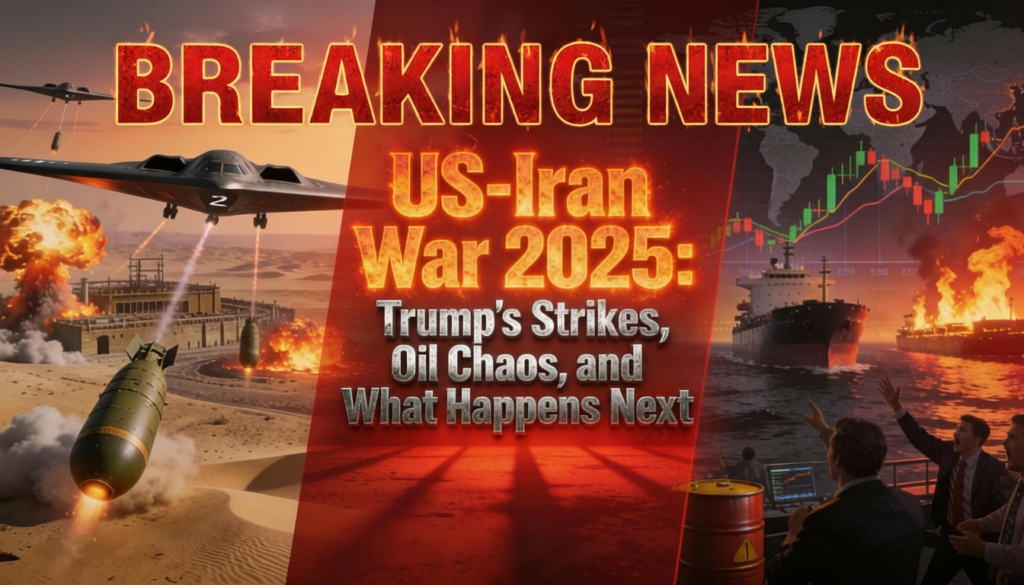
“US-Iran War 2025: Trump’s Strikes, Oil Chaos, and What Happens Next
Despite the fact that the tense relationship between Iran and the United States has resulted in decades of proxy battles, economic sanctions, military skirmishes, and diplomatic impasses, the two countries have never officially declared war. This rivalry, which has its roots in interventions during the Cold War and ideological clashes, reached new heights in 2025 with U.S.-backed strikes on Iranian nuclear sites. This blog post provides insight into why de-escalation remains crucial in light of global stakes by examining the history, key flashpoints, recent developments, and potential future paths. “War Between the US and Iran in 2025: Trump’s Strikes, Oil Chaos, and What Comes Next?

US-Iran War – Deep Historical Context
The CIA orchestrated Operation Ajax in 1953, overthrowing democratically elected Prime Minister Mohammad Mossadeq after he nationalized Iran’s oil industry. This marked the beginning of the divide between the United States and Iran. This coup brought back pro-Western monarch Shah Mohammad Reza Pahlavi, whose regime received billions in military aid from the United States, suppressing opposition and fostering resentment among Iranians. By the 1970s, the Shah’s brutal SAVAK secret police and Westernization efforts sparked the 1979 Islamic Revolution, led by Ayatollah Ruhollah Khomeini.
The Iran Hostage Crisis, in which revolutionaries seized the United States, was the immediate result of the revolution. Embassy in Tehran, holding 52 Americans for 444 days. The United States was humiliated by President Jimmy Carter’s unsuccessful rescue mission, which resulted in severed ties, asset freezes, and the first sanctions. This time period saw Iran transform into an anti-American theocracy and spread its revolution through organizations like Hezbollah. Understanding this background reveals the persistence of mutual distrust—America seeing Iran as a sponsor of terrorism and Iran seeing the United States as an imperialist bully.
Major Military Flashpoints
The 1980-1988 Iran-Iraq War tested U.S. resolve. To counter Iran’s zeal, Washington provided Iraq with satellite intelligence, chemical precursors, and loans despite Saddam Hussein’s invasion. The “Tanker War,” in which both sides attacked Gulf shipping, marked the height of tension. The United States Operation Praying Mantis, launched by the Navy, resulted in the destruction of two Iranian oil platforms, the sinking of a frigate, and the downing of jets—the nation’s largest naval surface engagement since World War II. Conflicts persisted after the Cold War, with the 2003 U.S. invasion of Iraq empowering Shia militias supported by Iran. Soleimani’s Quds Force orchestrated attacks on American forces, which culminated in President Trump’s 2020 drone assassination. Stuxnet, a U.S.-Israeli worm that sabotages centrifuges, and Iranian hacks of U.S. infrastructure were seen in cyberspace. Proxy wars in Yemen, Syria, and Lebanon via Houthis, Assad allies, and Hezbollah keep the embers glowing.
The 2025 Escalation
June 2025 marked a risky turn. Under President Trump’s second term, Israel used bunker-busters from B-2 bombers to launch preemptive strikes on Iran’s Natanz and Fordow nuclear sites with support from the United States. Trump praised it as a “very successful attack” to stop Iran from enriching uranium to levels close to weapons grade. Iran responded by launching missile barrages at Israeli targets and launching drone swarms at American bases in Iraq, promising “severe punishment.” Overnight, oil prices increased by 20%, reaching $100 per barrel and raising concerns about inflation. Saudi Arabia and other Gulf allies strengthened their defenses, and Russia and China condemned the strikes and provided Iran with S-400 systems. Despite the absence of a ground invasion, the exchanges resulted in dozens of deaths and thousands of displaced people, echoing the tanker crises of 2019.
Economic and Global Ripples
The standoff has significant repercussions beyond the battlefield. Since 2018, sanctions imposed by the United States have reduced Iran’s oil exports by 90%, resulting in a 7 percent decrease in GDP in 2024 due to hyperinflation. However, “maximum pressure” encouraged hardliners and sped up nuclear advancements. The Strait of Hormuz, through which 20% of the world’s oil flows, could be closed off in a full war, triggering a recession worse than 1979’s. Add value: Strategically, Iran’s asymmetric arsenal of Shia militias, fast-attack boats, and more than 5,000 ballistic missiles deters invasion but encourages escalation. Airpower and allies are favored by the United States as a result of lessons learned from Iraq and Afghanistan. For investors, safe havens like gold surged; diversifying into renewables hedges oil shocks.
Pathways to Stability
De-escalation necessitates inventiveness. Given that Iran’s economy recovered by 12% following the 2015 agreement, restarting nuclear talks in the style of the JCPOA with sunset clauses on enrichment could lessen sanctions. Extremists may be isolated by regional forums like the Abraham Accords expansions. As demonstrated by the Qatar-mediated prisoner swaps in 2025, Trump’s “peace through strength” combines outreach with deterrence. In the end, restraint benefits both nations: Iran’s problems at home and China’s. History warns against endless wars; prosperity is unlocked through dialogue, not dominance. The world waits to see if sanity prevails as 2025 draws to a close.For more details read this article.
Book mark our website for more updates.
Join us on Facebook
Follow us on Instagram
Subscribe on Youtube
We are on Pinterest Now.