

Tragic High-Speed Train Collision Rocks Southern Spain
Near Córdoba, a devastating collision involving two high-speed trains left over 100 passengers injured.
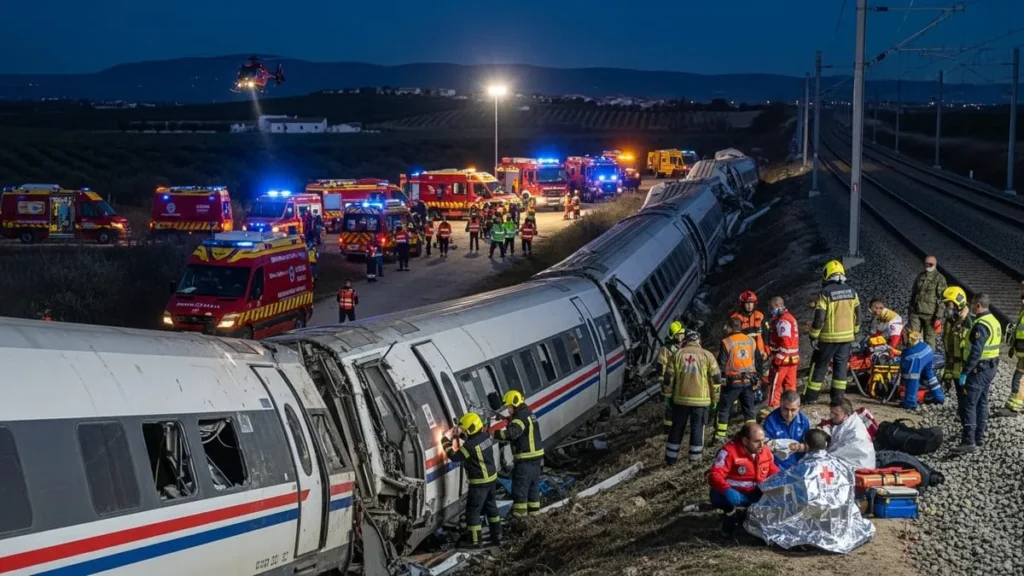

High-Speed Train Collision – Incident Overview
On January 18, 2026, the incident took place close to the town of Adamuz in the Córdoba province, around 6:40 p.m. local time. An Iryo train traveling from Málaga to Madrid derailed on a straight section of track recently renovated in May 2025, with its rear carriages veering onto the adjacent line. The front two carriages of a Renfe-operated Alvia train traveling from Madrid to Huelva were thrown off a four-meter embankment when this struck the train at approximately 200 kilometers per hour (124 miles per hour). At least four carriages were broken up by the impact, trapping passengers in the broken glass and bent metal. Both trains carried approximately 400 passengers, the majority of whom were Spaniards returning from weekend getaways in Andalusia. Spanish Transport Minister Óscar Puente called the derailment “really strange” on a straight stretch, noting no immediate cause was identified.
Casualties and Rescue Efforts
State broadcaster RTVE, citing police sources, reports that the death toll rose to 39 on January 19, with at least 21 confirmed at first, including one train driver. From 100 to 152 injuries, 25 to 73 people were hospitalized, with 15 to 24 in serious or critical condition in six facilities, mostly in Córdoba. Under floodlights throughout the night, hundreds of emergency personnel, firefighters, and heavy machinery were mobilized for rescue. According to social media videos and eyewitness accounts, passengers used emergency hammers to break windows and escape. The chief of Andalusia’s health, Antonio Sanz, and the president of the region, Juanma Moreno, issued a warning that the death toll could rise further during the debris removal process. Travelers were left stranded when the rail operator Adif suspended services between Madrid and Andalusia.Official Response and Investigation
Minister Puente addressed reporters from Madrid’s Atocha station, emphasizing the “terrible” force of the crash and vowing a thorough probe. Adif confirmed the Iryo 6189 derailed roughly 10 minutes after departing Córdoba, crashing onto the Renfe train’s path. Moreno described the scene’s severity, predicting more victims might be found under debris.
No definitive cause has emerged, but authorities rule out terrorism; focus lies on potential track, signal, or mechanical failures. The derailment’s oddity on renewed straight track raises questions about maintenance standards. Forensic teams and Spain’s rail safety agency are analyzing black boxes and wreckage.
Eyewitness Accounts
Survivor Salvador Jimenez, a TVE journalist on the Iryo train, described chaos as coach 6 derailed 10 minutes post-departure, lights failing amid violent shaking. “Ten minutes after departing, the train started to shake a lot,” wrote another passenger on X. The lights stopped working. Responders were seen on video assisting evacuees from downturned carriages while the injured were carried on stretchers. The crash’s ferocity on a crucial Málaga-Madrid route was highlighted by footage from the BBC that showed rescuers searching the wreckage for survivors.
At least one train driver from the Renfe Alvia service has been identified as one of the confirmed victims, and their families are currently gathering at Córdoba hospitals to await DNA identification. Córdoba fire chief Paco Carmona, one of the survivors, described how twisted metal ensnared passengers in the Renfe carriages and necessitated hours of cutting. In spite of the remoteness of the rural disaster site, locals near Adamuz fed and housed 450 displaced passengers, demonstrating community solidarity.
Rail Safety in Spain
Spain has one of the most advanced high-speed networks in Europe, with private operators like Iryo and AVE competing on routes that exceed 300 kilometers per hour. However, this is the first major incident since the 2013 derailment at Santiago de Compostela, which resulted in 79 deaths and prompted safety improvements. The tragedy on Monday brings to light flaws despite recent investments in signaling and tracks that were intended to prevent such incidents. Approximately 400 daily high-speed trains serve millions annually, making disruptions widespread. In keeping with reforms implemented after 2013, unions may demand reviews of how privatization affected maintenance.
Travel Disruption
Adif halted all high-speed services between Madrid and Andalusia, resulting in the cancellation of more than 50 trains and the stranding of thousands of people. The replacement buses extended travel times by four to six hours. The United States and other embassies are issuing alerts to tourists urging them to steer clear of Córdoba-Adamuz routes. Spain’s most important economic corridor was impacted when regional president Juanma Moreno activated emergency funds for rail alternatives.
National Mourning and Implications
As families awaited the identification of the victims, Spain entered mourning. Federal-regional aid was coordinated by the Prime Minister’s office, and EU transport officials provided expertise. Insurers prepared for claims exceeding millions as rail stocks fell. Services will not resume until January 19 as a result of the crash, which disrupts crucial economic ties between Andalusia and Madrid. Public outrage grows over safety lapses, pressuring Renfe, Iryo, and Adif for transparency.
Investigation Updates
The black boxes of the Iryo (Málaga-Madrid, more than 300 passengers) and Renfe (Madrid-Huelva, fewer than 100 passengers) trains were found by Spain’s rail safety agency, which revealed speeds close to 200 kilometers per hour at impact. The derailment occurred ten minutes after Iryo left Córdoba on renovated straight track, excluding curves but raising questions about signal failures, according to Transport Minister Scar Puente. Prime Minister Pedro Sánchez cleared his schedule on January 19 to visit the site, promising federal aid.
Broader Context
Tourists were spared during January’s off-peak hours, but weekend visitors were hit hard. Global outlets like NYT, Reuters, and BBC amplified the story, drawing parallels to past rail disasters. Spain must decide how to safeguard its rail future amid expansion as investigations continue. Despite advancements in technology, this event, which occurred just hours ago on January 19, 2026, highlights the risks associated with rail travel. A nation mourns, investigates, and hopes for answers to prevent future incidents.
For more details read this article.Book mark our website for more updates.
Join us on Facebook
Follow us on Instagram
Subscribe on Youtube
We are on Pinterest Now.