

Heartbreaking News: Ajit Pawar’s Plane Crash
In the Baramati plane crash, Ajit Pawar’s sudden death has created a significant and unexpected gap in Maharashtra’s public life. It has felt more like the death of someone they had grown up seeing on television screens, on hoardings during elections, and on stages during rallies and other public events to many people. Even if you didn’t agree with everything he stood for, it’s hard to deny that his presence persisted and was almost woven into the political history of the state. The majority of people instinctively hoped that his aircraft had “met with an accident” near Baramati on January 28, 2026, when the first alerts flashed. The human mind tries to negotiate with reality when it receives bad news. It could have just been a hard landing. It’s possible that everyone had made it out safely.
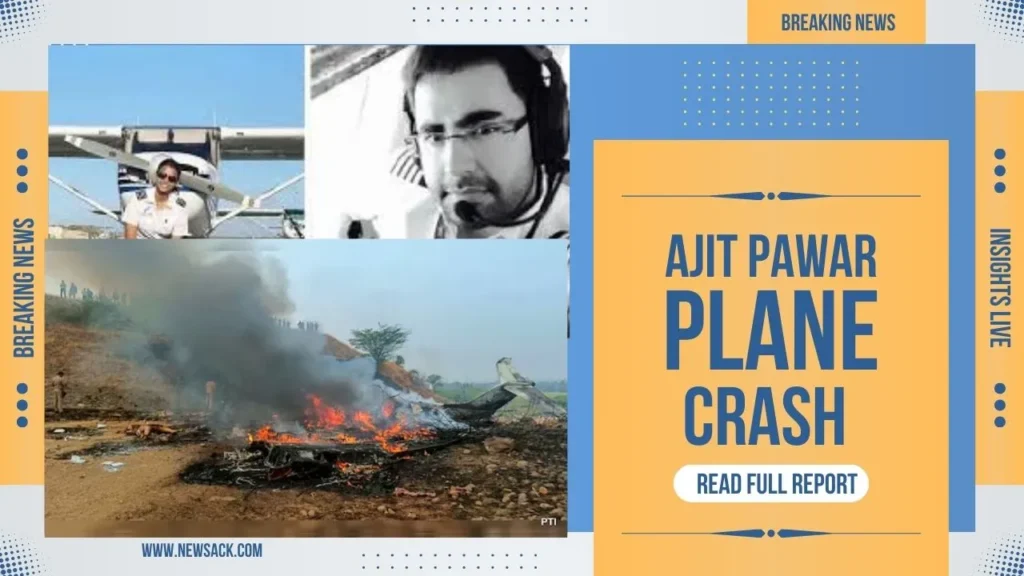

Perhaps the initial accounts were exaggerated. People throughout Maharashtra and beyond kept refreshing their news feeds, clinging to those “maybes” and hoping for a line that read, “All on board are safe.” Instead, over the course of the following hour, the information gradually became more gloomy and clear: the plane had gone down, caught fire, and there were no survivors. The loss of a loved one in an accident is especially upsetting. Even if a disease strikes suddenly, it still follows biological logic. An accident seems random, almost cruelly so. A man who had survived political coups, party splits, inquiries, and intense public scrutiny was here. He had gotten through a lot of criticism, fought back when people thought he was out, and stayed at the center of Maharashtra’s power structure for decades. The loss feels tragic and strangely incomplete to think that his story would end not in a carefully planned retirement or gradual retirement but in a few chaotic seconds as a plane tried to land.
The pain is even more personal to the people of Baramati. In many ways, Ajit Pawar was “their” leader in addition to being a senior leader. They were accustomed to seeing him at local events, cooperative societies, sugar factories, and schools. They expected to approach him for a favor, a recommendation, or a problem that required support from the political establishment. His morning flight from Mumbai to Baramati was supposed to be just another routine one: a day of meetings, public addresses, handshakes, garlands, and speeches. He had repeatedly followed the instructions. It is so emotionally jarring because of the idea that this familiar routine would suddenly turn into a disaster. The setting up of the stage, the arrangement of the chairs, the fluttering of banners with his picture on them, the testing of the sound system, and local workers giving last-minute instructions can all be pictured at the rally venues that day. It’s possible that some of his supporters had driven all the way from nearby villages in the wee hours of the morning just to see him in person and hear him speak. Those same supporters would have remained at the stage, staring at the empty stage as word spread that the man whose face was on every banner would never show up. The true weight of such a death is felt in small, quiet moments like these, when microphones remain off and processions do not begin.
After Ajit Pawar Plane Crash Family is in Grief
The loss has repercussions for his family that go far beyond public grief and state honor. The man who bore the moniker “Deputy Chief Minister” or “Party Leader” was also a father, husband, relative, and senior who held a special place in the family. Politicians’ families frequently become accustomed to the constant public scrutiny, security cordons, last-minute changes, and packed schedules. They learn to tell millions of strangers about their loved one. A family, on the other hand, can never be prepared for the one phone call that informs them that there were no survivors in the crash. The subsequent rituals, such as identification, formal announcements, the arrival of dignitaries, and gun salutes, can occasionally feel disjointed, almost like a script the family is forced to follow while they are still emotionally numb. The images that have emerged from Baramati over the course of the subsequent days—long lines of people waiting in the sun with flowers in their hands, elderly villagers slowly walking with folded palms, and young supporters holding his photograph close to their chest or wearing black ribbons—tell their own story. These are not just a group of people; rather, they are individuals with unique memories, tales, or at the very least feelings associated with their names.
A school that was upgraded, a road that was finally built, or a hospital that was approved might come to mind for some. Others might simply recall seeing him in a motorcade that was going by. In such situations, grief is frequently rooted in a sense of routine and familiarity, and it is not always logical or proportional. It can feel strangely hollow to be without someone who has been a part of your life for a long time. The manner in which leaders from various parties have reacted has also stood out. Opponents use harsh language, wage aggressive campaigns, and engage in contentious disputes during the ferocity of politics. However, when a tragedy such as this occurs, a distinct, more human layer emerges. Rivals stand side by side with their heads bowed, acknowledging that despite their daily fights over power and policy, they all agree that life is fragile and that no position, convoy, or protocol can completely shield a person from fate. Political differences are temporarily transformed into shared humanity during a condolence meeting’s collective wreath-laying ceremony.
Naturally, there is a strong undercurrent of questions alongside the grief. Could we have avoided this? Was the aircraft in excellent working order? Have all safety procedures been followed? Did the weather make it impossible to land? People rarely accept “accident” as a complete explanation when a public figure dies in such circumstances. They want specifics, justifications, and a story they can stick with. When aviation safety is rarely discussed, technical terms like “black box,” “approach path,” “visibility,” and “pilot error” begin to circulate. Families of the crew and staff on board carry their own quieter grief, which sometimes receives less attention but is just as heavy. They, too, set out for work that morning with the expectation of a typical workday, unaware that it would be their last. The news may have evoked a complex mix of emotions for many common citizens, particularly those who are not deeply involved in politics: sadness, shock, flight phobia, or even a more general reminder that life can change in an instant. Even though they weren’t his supporters at the polls, some people still feel a human sadness at the thought of someone’s death. Others who looked up to him or thought he was a strong leader might feel like they’ve been “orphaned” politically, not knowing who will now take his place or speak with the same authority for their area. People are also encouraged to consider the frantic pace and pressure of public life during such instances.
Politicians frequently move around, meeting in multiple cities in a single day, flying early in the morning after late-night meetings, and constantly adjusting their schedules to meet demands. It’s easy to forget that a human body is attempting to deal with fatigue, stress, and travel behind the speeches and security. For many people who have been following this tragedy, the image of a leader boarding a small aircraft at dawn or early morning and flipping through files or talking on the phone now carries a new weight. It teaches us that the strong, self-assured faces we see on stage are not invincible; they are just as susceptible to life’s uncertainties as anyone else. A natural question for those who admired Ajit Pawar now is how to remember him. Some people will remember his tactics in politics, his ability to negotiate, and his role in shaping governments. Others will remember smaller, more intimate acts, like calling a supporter on their behalf, going to a flood-ravaged area, or telling a joke at a rally that made everyone laugh. The initial shock of the accident will pass over time, but these tales will continue to be told to children: “I once saw him speak here” or “He helped get this project approved.” Memory works this way: it turns public figures into a mix of big events and small anecdotes.
Baramati in Politics After Crash
Even if you live far from Baramati or are not very involved in politics, it is perfectly normal to be affected by this news. People’s deaths have a way of making us think about our own lives, the unknowns of the future, and the people we care about. You might feel a need to talk about it, post a message, write a short note, or simply sit with your thoughts for a while. That, too, is a form of paying respect.
For more details read this article.Book mark our website for more updates.
Join us on Facebook
Follow us on Instagram
Subscribe on Youtube
We are on Pinterest Now.